How can a small force lift a heavy load? Why does a solid object feel lighter underwater? Archimedes brought mathematics to questions like these, uncovering relationships that people could use to understand and build things.
He lived in Syracuse more than two thousand years ago. His surviving books study balance, floating bodies, and geometry. The water screw is one part of that larger legacy: using mathematical reasoning to explain the physical world.
A long lever, a small effort
A lever turns around a support called a fulcrum. Push farther from that support, and less force can balance the same load on the other side. The longer end travels farther as the load rises. Archimedes gave this relationship a mathematical treatment in his work on equilibrium.
He also explained buoyancy: a body immersed in a fluid experiences an upward force equal to the weight of the fluid it displaces. That relationship helps explain floating ships and the apparent loss of weight when an object is lowered into water.
Was the crown really pure gold?
According to the later Roman writer Vitruvius, King Hiero suspected that a goldsmith had replaced some of the gold in his crown with silver. Archimedes needed to investigate without destroying the crown.
Gold is denser than silver. A crown containing silver would occupy more space than pure gold of the same weight. In Vitruvius' account, Archimedes compared the water displaced by the crown and equal weights of gold and silver to expose the substitution.
Vitruvius wrote roughly two centuries after Archimedes lived. The crown test and the bath-time cry of “Eureka!” belong to a later tradition whose details are uncertain. Archimedes' mathematical work on buoyancy survives independently of that story.
Turn a spiral, lift water
Imagine a field above a stream. The water is close, but it is too low to reach the crops. Every bucket must be lifted. How could a turning motion carry water uphill?
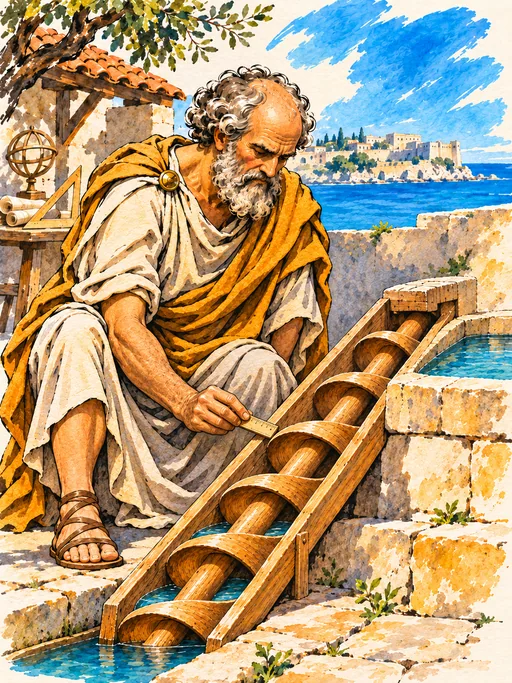
A screw offers a wonderfully simple answer. Tilt a spiral inside a close-fitting trough, dip its lower end into water, and turn it. Water caught between the blades rises toward the top. The person turning the screw supplies the energy; its shape guides that effort into useful work.
Ancient writers credited Archimedes with the water screw, although its precise origin and invention date are uncertain. That useful spiral still has new surprises to offer.
A machine small enough to be one molecule
On October 22, 2026, researchers reported a molecular relative of that familiar spiral in Nature. Anil Kumar Singh, Oren Tal, and an international team suspended a single corkscrew-shaped molecule, called a helicene, between two gold electrodes.
Apply a voltage, and the molecule moves. Reverse the voltage, and its preferred direction reverses. The evidence came from repeating patterns in the measured current, supported by calculations explaining how the current could exert a turning force.
Then came a surprise: above a threshold voltage, the current could rise by as much as a hundredfold. The team's calculations explain this as a change from stepwise movement to continuous rotation, which lets the molecule adopt shapes that conduct more readily. Stretching or compressing it changed the threshold.
An ancient shape, a new possibility
The experiment operated near absolute zero. It is an early laboratory machine; useful devices and room-temperature operation still lie ahead. The extra current flows under an applied voltage. The study does not demonstrate a molecule generating electricity from an outside source of mechanical work.
An irrigation screw and a molecular rotor do different jobs through different physics. What connects them is the astonishing usefulness of a helix: shape can help determine how motion and flow interact.
The lever, the floating body, and the screw show the reach of Archimedes' legacy. A relationship understood clearly can become a tool: a way to move a load, investigate a material, or imagine a new machine.

 AI